Reviewed by Shabnam Akrami. Updated 26 November 2026.
Short answer: An invitation letter explains who is inviting you, why you are visiting, where you will stay and how the trip will be paid for. It supports a visitor visa application; it does not replace your own evidence or guarantee approval. Follow your personalised IRCC checklist and any instructions from the visa office responsible for your application.
An invitation letter for a visitor visa to Canada works best when it describes a real, manageable visit. A warm invitation can help explain your relationship, but a clear plan matters more than a promise that everything will be fine. This guide provides an original planning sample, not an IRCC form or a pre-approved legal document.
Key takeaways
- Match the invitation dates to the application, leave approval and proposed travel plan.
- State exactly which expenses the host will pay and which the visitor will pay.
- Use genuine host information and evidence of the relationship.
- An ordinary invitation is different from the financial support commitment required for a Super Visa.
- Check local instructions before deciding whether notarisation or additional documents are needed.
Start with the visit, not the template
Write down four answers before drafting: who is coming, what they will do, how long they will stay and who can afford the trip. If the answers are uncertain, a polished letter will not resolve the uncertainty.
For example, “My sister will visit for three weeks during my annual leave” gives the reader a useful starting point. Explain the planned accommodation and main activities. There is no need to invent an hourly itinerary. A family visit can include ordinary time together; it does not need an expensive tourist schedule to be genuine.
If the invitation relates to a graduation, wedding or another event, identify the event and its expected date. Do not present an unconfirmed date as fixed. If plans change after submission, consider whether the change needs to be communicated through IRCC’s instructions for your application.
For the wider process, read our Canada visitor visa application guide.
What information belongs in the letter?
IRCC’s invitation guidance separates information about the visitor from information about the person inviting them. Use the official list when checking your finished letter.
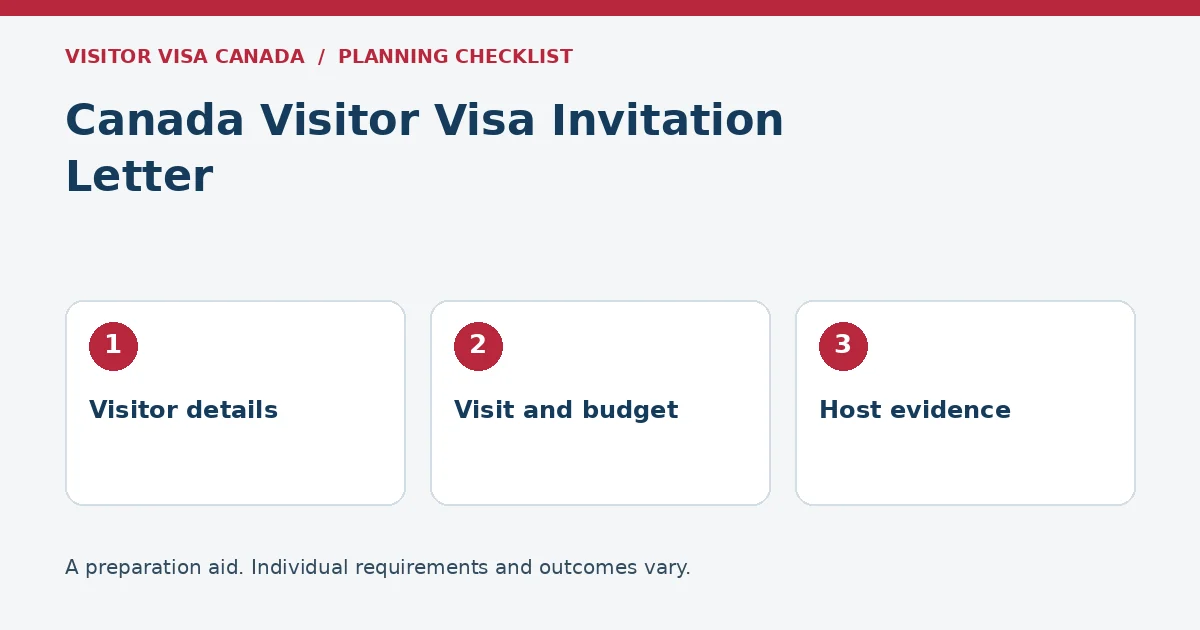
| Part of the letter | What to explain | Evidence to consider |
|---|---|---|
| Visitor | Identity, contact details and relationship to the host | Passport details and relationship records where requested |
| Purpose | Why the visit is happening now | Event information or a simple family visit explanation |
| Dates | Proposed arrival, length of visit and departure | A plan consistent with leave and other commitments |
| Accommodation | Address and who will provide the space | Host confirmation or genuine accommodation arrangements |
| Costs | Who pays for transport and living costs | Financial records that support the promise |
| Host | Identity, address, contact details, occupation and Canadian status | Applicable status documents and requested family details |
This is a planning table. The official instructions and your application checklist take priority. Avoid uploading unrelated identity documents simply to make the file larger.
Original invitation letter sample
Replace every bracket with truthful information. Delete anything that does not fit. The visitor and host should both read the final version.
Date: [day, month, year]
To Immigration, Refugees and Citizenship Canada,
I, [host’s full name], invite [visitor’s full name and date of birth], my [relationship], to visit me in Canada from [proposed arrival] until [proposed departure]. The visitor lives at [address] and can be contacted at [telephone and email].
The purpose of the visit is [specific, accurate explanation]. During the visit, we plan to [brief, realistic activities or event]. The visitor plans to return to [country of residence] on [date] to [truthful commitments, if relevant].
The visitor will stay at [address and accommodation arrangement]. I will pay for [specific expenses]. The visitor will pay for [specific expenses]. Supporting financial documents explain how these costs will be covered.
I live at [Canadian address] and work as [occupation, or accurate description of current circumstances]. My date of birth is [date]. My status in Canada is [status], supported by [document]. My household and family information is [details required by the applicable instructions].
I can be contacted at [telephone and email] if further information is needed. The information in this letter is accurate to the best of my knowledge.
[Signature and printed name]
Do not use this sample to promise that a visitor will obey every condition on the host’s behalf. The visitor remains responsible for their application and compliance. The host should state facts they actually know and commitments they genuinely intend to meet.
Connect the invitation to the financial evidence
A host who offers accommodation is not necessarily offering to pay for flights, food, insurance and every other cost. Separate these items. If the visitor has savings and the host provides a bedroom, explain that arrangement consistently in both the invitation and the financial summary.
Hypothetical example: A visitor plans a three-week trip. Her brother provides accommodation and meals; she pays for flights, local transport and insurance. A useful application shows her available funds and his capacity to provide what he promised. A letter saying “all expenses covered” would create an avoidable contradiction.
Use our visitor visa funds and trip-budget guide to organise the numbers. Do not copy a fixed balance from another person’s application and assume it applies to yours.
Check consistency before signing
Read the invitation beside the application forms. Compare names, dates, addresses, relationships and payment arrangements. Check whether the proposed stay fits the visitor’s employment, business or family commitments. An invitation for six months paired with two weeks of approved leave needs a truthful explanation.
Review translations and scanned pages. A missing signature page, blurred address or untranslated supporting record can make the invitation harder to understand. Follow IRCC’s translation requirements rather than assuming a translation by a relative is acceptable.
Keep a copy of the exact letter submitted. If the host updates it later, clearly identify which version belongs with the application. The aim is a consistent record, not multiple slightly different letters.
When professional help is useful
Consider a review if the visitor has a refusal, unclear finances, a long proposed stay or inconsistent previous information. A professional can help identify evidence gaps and explain difficult facts. Hiring a representative does not create special approval rights or priority processing.
Before a consultation, gather the proposed letter, the visitor’s travel plan and any previous refusal. Do not send passport numbers or financial records through an ordinary website enquiry form; ask the firm for an appropriate document-sharing method.
Frequently asked questions
Is an invitation letter always required?
Not every visitor has a Canadian host. Follow the checklist and the instructions for your visit purpose. If IRCC requests an invitation, provide one that addresses the requested information rather than relying on a generic tourism letter.
Can a friend invite me?
A genuine friend can explain the invitation and relationship. Family membership is not a substitute for visitor eligibility, and friendship does not disqualify an invitation. Describe how you know each other and the actual arrangements.
Must the letter be notarised?
Do not assume notarisation is universally required. Check your visa-office instructions and any specific request. Notarisation does not establish that the visitor meets the immigration requirements or that a visa will be issued.
Does the host become legally responsible for me?
IRCC explains that writing an ordinary invitation does not make the writer legally responsible for the visitor after entry. A Super Visa has separate financial support requirements. The host must still make truthful statements.
Can the host pay for the trip?
Yes, the application can explain genuine support. Identify the expenses and provide relevant evidence of capacity. The visitor still needs to establish the overall purpose and temporary nature of the stay.
Should I buy flights before applying?
Avoid treating a paid ticket as a guarantee of approval. Use the evidence requested by your checklist and consider the financial risk of non-refundable bookings. A proposed travel plan must remain realistic and truthful.
Can one letter invite both parents?
It can explain a shared trip, but identify each visitor and their individual circumstances clearly. Each applicant must meet the applicable requirements. Follow the portal’s instructions for family applications and supporting documents.
What if the host is a student or worker?
State the host’s actual Canadian status and its validity. Do not describe a temporary resident as a citizen or permanent resident. Check the instructions for the particular visit; Super Visa host eligibility is different.
Does an invitation fix a previous refusal?
Not by itself. Read the refusal reasons and any officer notes, then address the evidence gaps. Our visitor visa refusal guide explains the broader next steps.
Can I reuse this sample for a Super Visa?
Use it only as an organisational starting point. Super Visa applications require additional host, income, insurance and other evidence. Follow the official Super Visa eligibility guidance.
Your next step
Draft a factual invitation, compare it with the visitor’s documents and resolve contradictions before submitting. A short, accurate letter supported by evidence is more useful than a dramatic promise of approval.
Toll-free: 1-877-820-7121 · Send an online enquiry · Explore visitor visa resources
Prepared for Akrami & Associates. General information, not advice on an individual case. Requirements can change. Reviewed by Shabnam Akrami on 26 November 2026.