Reviewed by Shabnam Akrami. Updated 26 November 2026.
Short answer: A family-ties refusal usually raises a concern about whether the proposed visit is genuinely temporary. Having relatives in Canada does not automatically disqualify you. Review the actual refusal and any officer notes, then identify what your evidence did and did not show about your circumstances and plans.
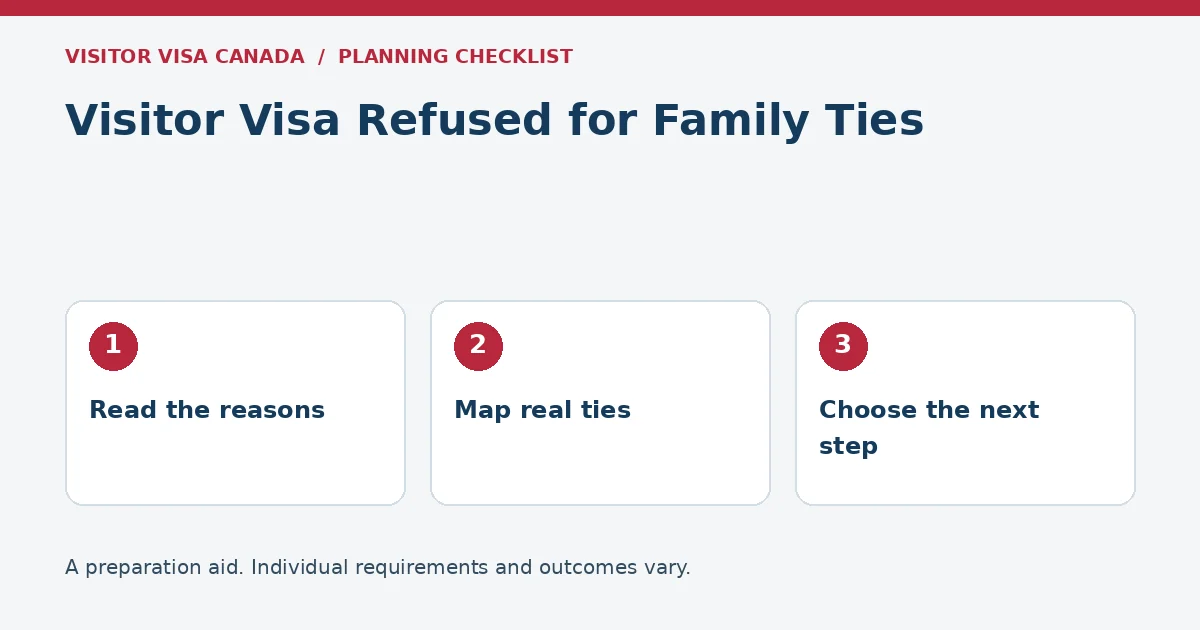
A Canada visa refusal involving family ties can seem contradictory: the reason for visiting is your family, yet the decision mentions those same connections. The useful response is not to hide relatives or repeat that you promise to return. It is to understand the concern and evaluate the evidence in context.
Key takeaways
- Disclose family relationships truthfully, including relatives in Canada.
- Read the decision as a whole rather than responding to one phrase alone.
- Home ties can include responsibilities, work, business, study and lawful residence.
- More documents are useful only if they address a relevant gap.
- Consider legal advice promptly if you believe the decision overlooked important evidence.
What does the officer need to assess?
IRPR paragraph 179(b) requires the decision-maker to be satisfied that the applicant will leave by the end of the authorised stay. Family circumstances can form part of that assessment, alongside the purpose, finances and other evidence.
Do not reduce this to a rule that “family in Canada is bad” or “owning property guarantees approval.” The issue is how the actual record supports the proposed temporary visit. An applicant may have close family in Canada and meaningful commitments elsewhere.
Our visitor visa refusal guide explains the broader options. This article focuses on organising evidence relevant to family ties rather than repeating the entire refusal process.
Read the letter and available notes together
Save the refusal letter, any officer decision notes and the exact application submitted. IRCC now provides notes with certain refusal decisions under its officer decision notes process. Check what you actually received before assuming a separate records request is the only way to learn more.
Mark each concern: family ties, purpose, funds, immigration history or another issue. A new family letter will not necessarily address a financial concern. If the reasons are unclear, avoid guessing at the officer’s thinking and presenting that guess as fact.
Also distinguish a missing document from an alleged failure to consider a document already submitted. Those situations can lead to different advice about a new application or review of the decision.
Make an evidence map
Create a table for your own preparation. The final application can use a concise explanation, but the working table helps reveal unsupported claims.
| Fact you want to explain | Why it matters to the visit | Possible evidence |
|---|---|---|
| You support a relative at home | Explains an ongoing responsibility | Genuine support records and relationship documents |
| Your job continues after leave | Connects the trip to a return date | Employer confirmation and approved leave |
| Your business needs your involvement | Explains continuing commitments | Contracts, operating records and absence arrangements |
| You live lawfully in another country | Clarifies your residence and ability to return | Residence permission and relevant expiry dates |
| You have a scheduled commitment | Explains a concrete reason to return | Genuine enrolment, appointment or contractual records |
These are examples, not mandatory documents for everyone. Do not invent a commitment because it looks persuasive in a checklist. Explain the facts you actually have.
Explain relationships on both sides of the trip
Identify who you will visit in Canada and why. Then explain the relevant people and responsibilities in your country of residence. A clear family picture is more useful than a collection of names without context.
If most close relatives live in Canada, acknowledge that fact. Focus on the real arrangements, the requested duration and the evidence of compliance rather than trying to create fictitious home ties. Some applicants are retired, single or do not own property. Those facts require honest explanation, not manufactured employment or assets.
If you live outside your country of citizenship, distinguish citizenship from residence. Explain where you currently live, your permission to remain there and your actual return plan. Do not casually promise to return to a country where you no longer have a right to reside.
A hypothetical example: a retired parent
A retired father requests a five-week visit to his daughter. The application includes an invitation but says little about his life at home. A refusal refers to family ties and the temporary purpose.
Before reapplying, he reviews what was submitted. He identifies genuine continuing responsibilities, pension arrangements, accommodation and a planned return. He also explains why five weeks fits the event and his circumstances. He does not obtain a fake employer letter simply because other applicants submit employment evidence.
This example illustrates an evidence review, not a successful case or a prediction. The new information must be assessed against the actual reasons and eligibility requirements.
Keep the duration and purpose consistent
A long visit can raise questions when the documents describe obligations requiring a quick return. Explain how responsibilities will be managed during the absence. If someone else will provide care or run a business temporarily, describe the real arrangement.
Do not shorten the stated visit solely to make an application look easier while secretly planning a much longer stay. Use a truthful plan and address how it will be funded. Our purpose-of-visit refusal guide explains how to check consistency across dates and evidence.
An invitation letter should complement the applicant’s explanation. It cannot independently prove every aspect of the visitor’s life outside Canada.
Reapply or assess legal review?
IRCC advises against simply reapplying with the same information when nothing addresses the refusal. Identify meaningful new evidence or changed circumstances before deciding on another application.
If the concern is an unreasonable or legally flawed decision, obtain legal advice promptly. Judicial review has strict deadlines and is not an automatic visa appeal or an opportunity to submit a completely new application to the judge. Do not let a records request or reconsideration request cause you to miss a court deadline.
The Federal Court’s immigration guide explains the procedure. A lawyer should assess the deadline and suitability for the particular decision.
Frequently asked questions
Does having a sibling in Canada cause refusal?
Not automatically. The relationship is part of the overall circumstances. Explain the genuine visit and relevant evidence rather than concealing the sibling or assuming the relationship decides the outcome.
Do I need to own property?
There is no universal property-ownership requirement for ordinary visitors. Explain the meaningful ties and responsibilities you actually have. A property deed alone does not establish that you will leave after the visit.
What if I am retired?
Use truthful evidence of your circumstances, such as pension income, residence, family responsibilities and the proposed trip. Do not create employment evidence for a job you do not hold.
Can a Canadian relative guarantee that I will leave?
A promise from the host does not replace the applicant’s eligibility assessment. The host can explain actual accommodation and support, but cannot guarantee a visa or bind IRCC to approve it.
Should I leave relatives out of the application?
No. Answer the questions accurately and fully. Concealment can create serious problems beyond the original concern about temporary intent.
Are family ties only about relatives?
The phrase in a decision should be read in context. Other connections, responsibilities and residence circumstances may help explain the proposed return. Do not assume a single type of document is always decisive.
Can a spouse visit while sponsorship is pending?
Possibly. Dual intent allows temporary and permanent intentions to coexist, subject to visitor requirements. Read our spouse visitor guide for that more specific situation.
How soon can I reapply?
Do not use speed as the main criterion. First assess the reasons and whether the new application meaningfully addresses them. Check whether any separate restriction or urgent review deadline applies.
Should I request officer notes?
Check the notes already provided with the decision. Further records may help in some cases, but obtaining records does not automatically extend a legal deadline. Get timely advice if review is being considered.
Will a longer explanation letter improve the case?
Length is not the objective. Use a clear explanation tied to relevant evidence. Repeated promises or pages of unrelated personal history can obscure the facts the officer needs to understand.
Your next step
Build an evidence map from the actual refusal and original application. Decide whether a truthful, materially improved application or legal assessment of the decision is the appropriate next step.
Toll-free: 1-877-820-7121 · Send an online enquiry · Explore visitor visa resources
Prepared for Akrami & Associates. General information, not advice on an individual case. Requirements can change. Reviewed by Shabnam Akrami on 26 November 2026.