Reviewed by Shabnam Akrami. Updated 26 November 2026.
Short answer: Some visitors who lose status in Canada can apply for restoration within 90 days, provided they meet the applicable conditions. Restoration is not automatic and is different from an extension filed before expiry. Identify the date status was lost and get advice promptly if that date or your eligibility is unclear.
Trying to restore visitor status in Canada can feel urgent and confusing. The first task is to reconstruct what happened, not to copy somebody else’s application. A visa sticker, a visitor record and an online application confirmation answer different questions.
Key takeaways
- Check the actual status-loss date; do not rely on the visa sticker’s expiry.
- A restoration request does not give you maintained status.
- Filing does not guarantee restoration or authorise work or study.
- Previous applications, refusals and incomplete submissions can affect the timeline.
- If more than 90 days have passed, do not assume the ordinary restoration process remains available.
Understand what restoration is for
An extension normally asks for more time while you still have status. Restoration asks to regain status after it has been lost, within the applicable framework. IRCC’s restoration answer explains the visitor process and the need to meet the conditions.
This guide concerns visitor status. Former workers and students can face different form, authorisation and eligibility issues. It is not safe to treat every temporary resident’s case as an ordinary visitor overstay.
For an unexpired stay, start with our visitor record extension guide. Choosing the correct process matters more than how quickly you can complete a form.
Build a timeline before calculating a deadline
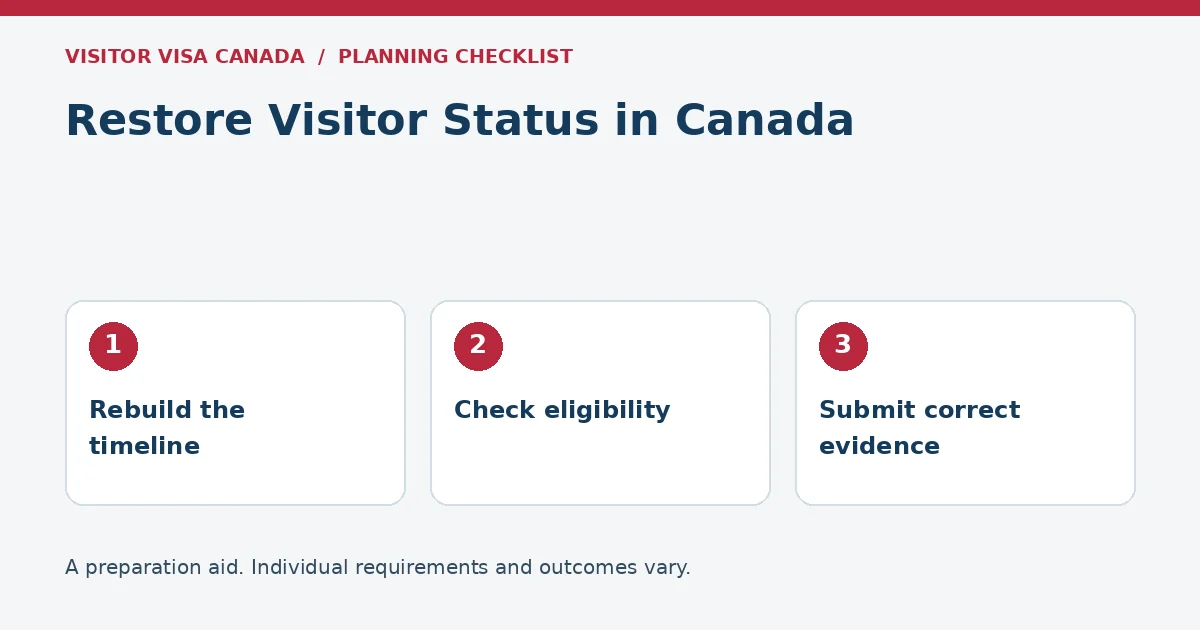
Collect the original documents rather than relying on memory. Write each relevant event in date order and identify the evidence for it.
| Event | Record to find | Question it helps answer |
|---|---|---|
| Last admission | Passport stamp and entry documents | When did this stay begin? |
| Authorised end date | Visitor record or other applicable status evidence | When was the stay due to end? |
| Extension submission | Submitted application and confirmation | Was a qualifying application filed in time? |
| Decision or return | IRCC letter and account message | Was it refused, withdrawn or rejected as incomplete? |
| Later action | Further application and payment records | What happened after the decision? |
An application you started but never submitted does not have the same effect as a submitted request. A payment receipt alone may not establish that the application was transmitted. Keep the complete confirmation and application copy.
If a refusal ended maintained status, that history matters when determining the relevant dates. An incomplete application can raise a different issue. Have a professional review the original letters if there is any doubt; a general online calculator cannot resolve ambiguous facts.
Check eligibility, not just the number of days
Being within a time window does not by itself establish eligibility. Review the conditions that applied to your stay, what caused the loss of status and whether you continue to meet the requirements for the requested status.
The legal framework includes IRPR section 182. Read it with IRCC Guide 5551, not as a promise that every overstay can be fixed.
Disclose work, study and other relevant activity accurately. If you may have breached a condition, obtain advice on its effect. Do not describe an application as a simple missed date if the record involves additional issues.
Explain the lapse honestly
A useful explanation describes the facts, dates and supporting evidence. It does not need emotional exaggeration. If illness, an administrative error or another event affected your ability to apply, explain what happened and provide relevant evidence where available.
Hypothetical example: A visitor relied on the expiry of a multiple-entry visa and overlooked the shorter authorised stay. The explanation should acknowledge that misunderstanding, identify the correct dates and explain the present request. It should not falsely claim a portal outage or invent medical circumstances.
Also explain how you will support yourself during the requested period and your plan to comply with future conditions. A truthful explanation of the past and a realistic plan for the future serve different purposes; include both where relevant.
Prepare the application record
Follow the current IRCC process and personalised checklist. The visitor form is generally IMM 5708, with the appropriate restoration selection, but confirm the route for your actual circumstances.
Organise the file into a clear sequence: identity and immigration history; timeline and explanation; supporting records; proposed stay and financial plan; required forms and payment. Do not assume an earlier refusal file is automatically incorporated into the new application.
Use the official current fee list. Restoration fees can change, so an old article or payment screenshot is not a reliable payment instruction. Keep the receipt and proof of submission separately.
Our visitor visa funds guide can help organise the budget, but restoration also requires assessment of the status history. A strong bank account does not erase a missed deadline.
What can you do while waiting?
Do not treat a restoration application as maintained status or as restored status. Filing does not itself authorise work or study. The applicable immigration conditions and any separate authorisation must be assessed.
Monitor your account and respond to requests on time. Keep contact information current. If you are considering leaving Canada, obtain advice about the effect on the application and any future admission. A visitor record, visa or pending request does not guarantee that you can return.
Avoid making employment, travel or schooling commitments based on an assumed approval date. Processing estimates are not guarantees, and the outcome remains uncertain until IRCC makes a decision.
If the ordinary restoration window has passed
IRCC’s guidance says that a person who is no longer eligible for restoration must leave Canada. Get prompt individual advice about your circumstances and any enforcement or travel issues. Do not keep submitting ordinary visitor extensions to create the appearance of valid status.
This article does not assess exceptional situations or every possible immigration process. The practical priority is an accurate timeline and a lawful next step, rather than a generic promise that a late application will be accepted.
Frequently asked questions
Is the deadline always 90 days from my visa expiry?
No. The visa sticker is not normally the measure of authorised stay. The relevant event is loss of status, which must be determined from your entry, status documents and application history.
Can I apply after an extension refusal?
Restoration may be available in some circumstances, but the refusal, dates and eligibility need review. Do not assume every refusal creates a new 90-day period regardless of the earlier history.
Does submitting restoration make me legal again immediately?
No. It is a request for restoration, not an approval. Do not describe yourself as having restored status merely because you paid and submitted the form.
Can I work while restoration is pending?
A visitor restoration application does not authorise work. Work-permit situations require separate analysis. Do not rely on a visitor application as permission to resume employment.
Can I leave Canada while waiting?
Departure can affect the practical and legal position. Obtain advice before travel and check future entry requirements separately. A pending restoration application is not a document guaranteeing return.
Is restoration guaranteed if I apply within 90 days?
No. You must meet the applicable conditions and provide a complete, truthful application. Being within the time window is only one part of the assessment.
What if the portal was not working?
Retain genuine evidence of the problem and the steps you took. Do not assume a technical problem automatically extends the deadline. Seek advice promptly and follow current IRCC reporting instructions.
Can my spouse’s valid status cover me?
No automatic coverage should be assumed. Each person’s immigration status must be assessed individually. A family relationship does not itself restore a visitor’s lost status.
What should I bring to a consultation?
Bring your passport, entry and status records, every recent application confirmation and decision, and a dated timeline. Tell the professional about all work, study and travel since entry.
What if I do not know when status expired?
Do not guess on the form. Gather the original evidence and obtain advice quickly. Uncertainty about the date is a reason to investigate promptly, not to delay until the issue becomes more urgent.
Your next step
Reconstruct the timeline today and have any uncertainty about eligibility or deadlines assessed. Accurate dates and full disclosure are the foundation of a responsible restoration decision.
Toll-free: 1-877-820-7121 · Send an online enquiry · Explore visitor visa resources
Prepared for Akrami & Associates. General information, not advice on an individual case. Requirements can change. Reviewed by Shabnam Akrami on 26 November 2026.