Category: Family visits

  • Visitor Visa for Parents: Choose the Right Family Visit Plan

    Visitor Visa for Parents: Choose the Right Family Visit Plan

    Reviewed by Shabnam Akrami. Updated 26 November 2026.

    Short answer: Parents may visit Canada through the ordinary visitor route or, if eligible, the Super Visa programme. Choose based on the intended stay and the actual requirements. A parent-child relationship does not automatically establish eligibility, and an ordinary visitor visa does not authorise an unlimited stay.

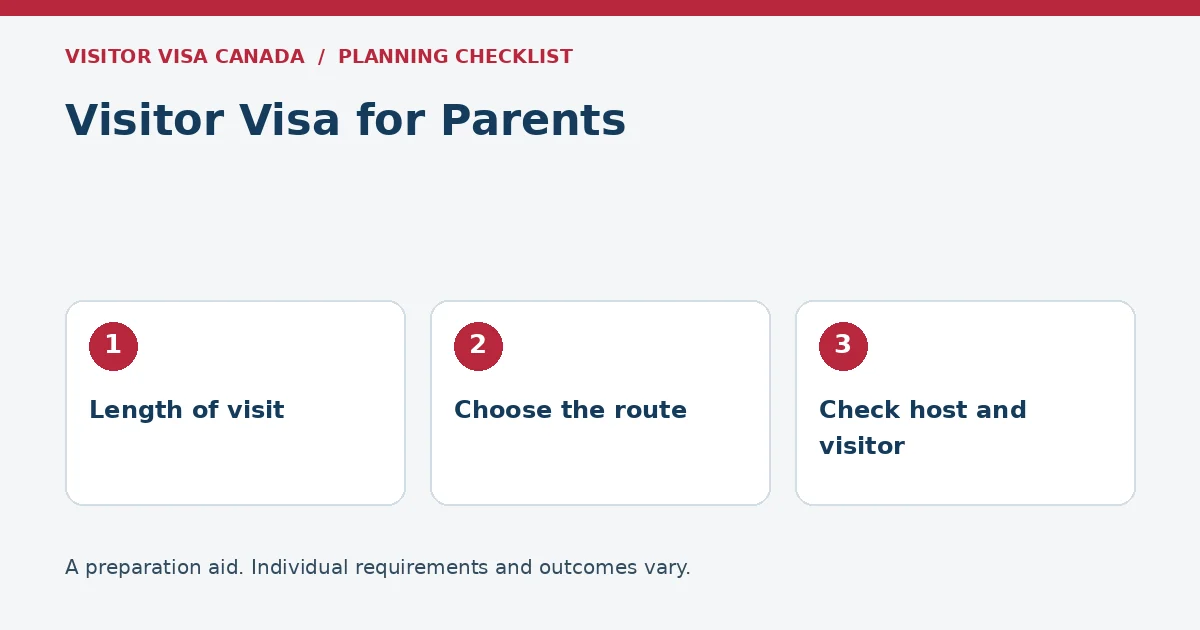
    Planning a visitor visa for parents in Canada begins with a family decision: is this a short visit or a longer stay? That answer affects the evidence, costs and route to assess. Do not start by copying another family’s document package.

    Key takeaways

    • Ordinary visitor requirements and Super Visa requirements are different.
    • The visa’s validity period is separate from the authorised stay on each entry.
    • Super Visa income rules changed in 2026; check the current official calculation.
    • Each parent must meet the applicable requirements.
    • Neither route guarantees admission or permanent residence.

    Compare the two visit plans

    Visitor Visa for Parents — planning comparison
    Question Ordinary visitor route Super Visa route
    Intended use A temporary visit, often shorter Longer visits by eligible parents or grandparents
    Typical stay framework Most visitors may stay up to six months, subject to the officer’s decision Eligible admissions can allow stays up to five years
    Host eligibility Explain the actual invitation and support Specific eligible child or grandchild requirements
    Financial assessment Evidence sufficient for the actual visit Specific host-income framework and supporting evidence
    Insurance and medical Check the requirements for the individual visitor Mandatory qualifying private health insurance and medical examination
    Permanent residence Not granted by a visit Not granted by a Super Visa

    Consult IRCC’s Super Visa eligibility page and visitor visa overview. This table is a route-selection aid, not a complete eligibility assessment.

    Begin with the parents’ actual circumstances

    Identify citizenship, current residence, travel documents, previous Canadian status and the proposed dates. Some travellers use an eTA or have other entry-document requirements instead of an ordinary visa. Check the applicable travel document before preparing a TRV application.

    Explain the purpose of the visit and why the duration fits. A graduation, family reunion or time with grandchildren can be described plainly. Do not turn a family visit into a fictional tourism programme because you think that sounds more acceptable.

    Our visitor application guide covers the general process. If a parent has a previous refusal, review it before selecting a new route. Applying under a different label does not erase immigration history.

    Ordinary visits: show a workable plan

    Prepare an invitation letter explaining the relationship, accommodation, dates and support. Identify who pays for flights, daily costs and other expenses. If both parents travel, account for both rather than budgeting for one person.

    Retired parents may have pension income, savings, a home and ongoing responsibilities. Explain those real circumstances. Do not provide an employment letter for someone who is no longer employed or assume retirement makes an application impossible.

    Use our funds guide to organise the budget. Ordinary visitor applications should not be assessed using an invented universal balance or the separate Super Visa host-income table.

    Super Visa: check host and applicant requirements

    The host must meet the programme’s criteria, including the qualifying relationship, status, age and residence requirements. The applicant must meet their own requirements, including applying from outside Canada and providing the required medical and insurance evidence.

    Do not assume any insurance sold online qualifies. Check the current rules for the insurer, policy period and coverage, and confirm the actual policy terms. An ordinary travel quotation is not automatically compliant Super Visa evidence.

    The programme is not a route for every family member. Siblings and other relatives should not be described as eligible parents or grandparents. Check separate requirements for anyone travelling with the applicant.

    What changed in the income rules?

    IRCC introduced additional ways to meet the Super Visa income requirement from March 31, 2026. Its current financial-support instructions explain both the family-size calculation and the evidence required.

    One option uses qualifying host and co-signer income from either of the two preceding tax years. Another allows eligible visiting parents’ or grandparents’ income to contribute when the host and any co-signer meet the specified minimum share. The current instructions state a 75% host/co-signer threshold for that second option and require the combined income to meet the full amount.

    Use the live instructions for the applicable amounts and documents. Do not assume every relative’s income can be included, that savings are interchangeable with qualifying income or that a spouse living elsewhere is excluded from family size. The calculation deserves careful review.

    A hypothetical route-choice example

    A daughter wants her retired parents to visit for three weeks around a family event. The family reviews ordinary visitor requirements and prepares a realistic short-trip plan. They do not choose a Super Visa merely because its stay allowance is longer.

    A different family genuinely plans an extended visit. They assess Super Visa host income, family size, insurance and medical requirements before applying. If they do not qualify, they do not represent a multi-year plan as a short holiday to avoid the requirements.

    These examples illustrate planning questions, not recommendations for every family. The correct route depends on the actual facts and current rules.

    Prepare the family documents consistently

    Check names and dates across birth certificates, passports, invitations and status records. If a name changed, provide the required evidence and explanation. Follow translation instructions for documents not in English or French.

    Each parent’s evidence should be clear even where some documents are shared. Explain joint finances without double counting funds. If one parent travels and the other remains home, describe the actual arrangement without exaggerating dependency or responsibilities.

    Use the current application instructions and the appropriate Super Visa process where relevant. Older videos may show outdated portal questions or financial rules.

    After approval: track the stay separately

    Read the entry and status documents on arrival. Do not assume a multiple-entry visa permits continuous residence until it expires. If an extension becomes necessary, assess the visitor record process before the current stay ends.

    Discuss insurance and medical-cost arrangements before travel. Do not assume visiting parents automatically receive provincial health coverage. Check the applicable province’s rules and actual insurance terms.

    For broader programme information, see TheVisa.ca’s Super Visa guide. Permanent residence sponsorship is a separate process and is outside the scope of this visit-planning article.

    Frequently asked questions

    Can I invite parents if I am a student or worker?

    You can explain a genuine ordinary family visit and your actual status. Super Visa host eligibility is more specific. Do not assume a temporary resident qualifies as a Super Visa host.

    Is a Super Visa always better?

    No. Consider the real intended stay, eligibility, insurance and financial requirements. A longer permitted stay is not automatically the right fit for a short family trip.

    Can parents stay for ten years on a visitor visa?

    Visa validity and the authorised period of each stay are different. A long-validity visa does not give continuous permission to remain for that entire period.

    Is there a fixed bank balance for an ordinary parent visit?

    There is no universal ordinary-visitor balance. Explain the actual costs, funds and genuine support. Do not confuse this with the Super Visa’s specific income framework.

    Can parents’ income count for a Super Visa?

    Under a current option it may contribute if the host and any co-signer meet the specified threshold and the other requirements are satisfied. Follow IRCC’s current calculation and evidence instructions carefully.

    Do both parents need separate assessment?

    Yes. Shared documents do not eliminate each person’s eligibility requirements. Ensure each applicant’s identity, history, finances and planned stay are accurately addressed.

    Can a visa-exempt parent use the Super Visa programme?

    IRCC provides a process for eligible visa-exempt applicants, including an approval letter and any required eTA for air travel. Follow the official instructions for the particular traveller.

    Does a previous refusal prevent another application?

    Not automatically, but disclose it and address the reasons. A new invitation alone may not resolve the problem. Review our refusal guide first.

    Is a parent’s visit permission to work or provide services?

    A visitor document does not itself authorise work. If planned activities could raise work-authorisation issues, obtain advice on the facts rather than relying on the family relationship.

    Can the firm guarantee approval for my parents?

    No. A professional can assess the route and evidence, but IRCC decides the application and border officials assess admission. No invitation, insurance purchase or representative guarantees success.

    Your next step

    Agree on the genuine length and purpose of the visit, then assess the appropriate route and evidence. Recheck current Super Visa financial requirements before any application is submitted.

    Toll-free: 1-877-820-7121 · Send an online enquiry · Explore visitor visa resources

    Prepared for Akrami & Associates. General information, not advice on an individual case. Requirements can change. Reviewed by Shabnam Akrami on 26 November 2026.
  • Visit Your Spouse in Canada While Sponsorship Is Pending

    Visit Your Spouse in Canada While Sponsorship Is Pending

    Reviewed by Shabnam Akrami. Updated 26 November 2026.

    Short answer: A spouse or partner may apply to visit Canada while a permanent residence sponsorship application is pending. The applicant must still meet visitor requirements. Dual intent allows temporary and permanent intentions to coexist, but it does not guarantee a visa or remove the requirement to leave when required.

    For couples living apart, a visitor visa for a spouse in Canada can be an important question. This guide focuses on the temporary visit during sponsorship processing. It does not replace a full sponsorship eligibility assessment or promise a particular processing time.

    Key takeaways

    • Disclose the sponsorship and relationship accurately.
    • Explain a genuine temporary visit and what happens if permanent residence is delayed or refused.
    • An acknowledgement of receipt may be relevant to faster processing for eligible applicants, but approval is not guaranteed.
    • Permanent residence processing does not automatically maintain visitor status.
    • A visitor visa does not itself authorise employment.

    Understand dual intent in plain English

    IRPA subsection 22(2) recognises that intending to become a permanent resident does not prevent someone from qualifying as a temporary resident, provided the officer is satisfied they will leave by the end of the authorised period.

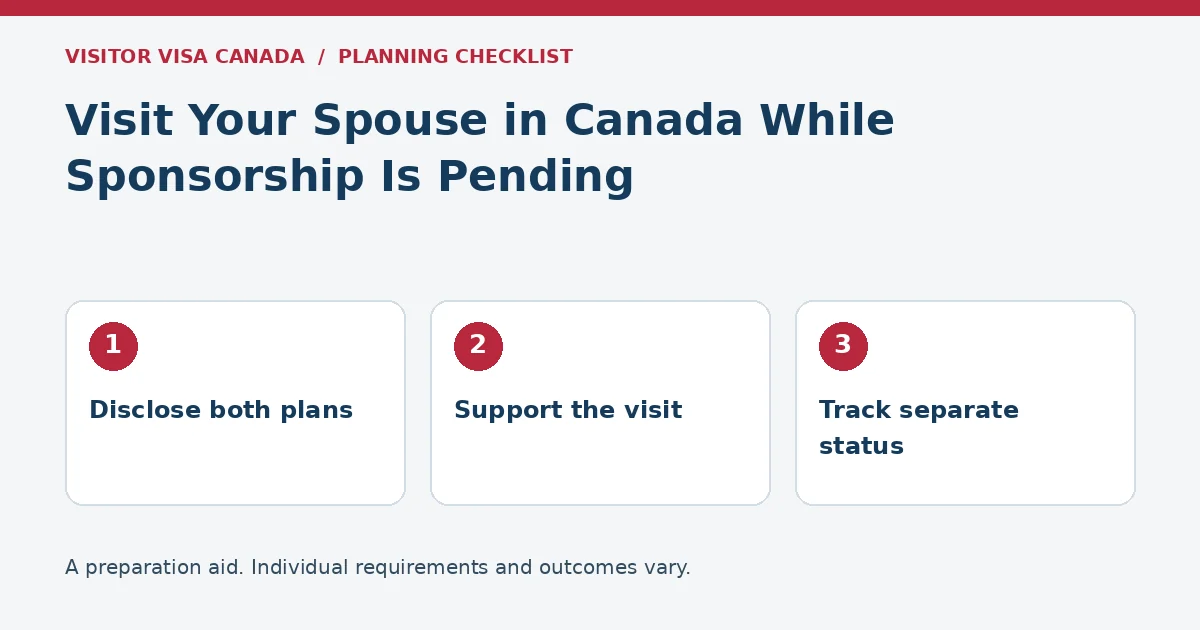
    The practical point is honesty. You do not need to pretend there is no long-term plan. You do need to explain how the temporary visit will comply with its conditions if permanent residence is not granted in time.

    “We hope to live together permanently” and “I will comply with the end of my authorised stay” can both be true. The application should support that explanation with the actual circumstances, not simply quote the term dual intent.

    Keep the applications separate

    Visit Your Spouse in Canada While Sponsorship Is Pending — planning comparison
    Question Visitor application Sponsorship application
    Main purpose Permission for a temporary visit Assessment for permanent residence
    Key practical plan Dates, support, accommodation and compliance The applicable sponsorship and relationship requirements
    Effect on work No work authorisation merely from a visitor visa A separate work-permit route may be available if eligible
    Effect on status Authorised stay must be tracked Filing PR does not automatically extend visitor status

    For the basic temporary requirements, read our visitor visa guide. For the permanent residence process, use TheVisa.ca’s spousal sponsorship guide.

    What role does the AOR play?

    An acknowledgement of receipt, or AOR, confirms that the permanent residence application is in progress in the relevant IRCC process. It is not permanent residence approval and does not itself grant visitor status.

    IRCC’s current sponsorship guidance explains that eligible spouses or partners may receive faster visitor processing when the sponsor has received the AOR and the visitor requirements are met. Eligible applications receive this automatically; it is not a paid representative privilege.

    Do not advertise or plan around a guaranteed number of days. Cases requiring more information can take longer. Follow the current visitor application instructions for sponsored spouses and partners when selecting the application route and documents.

    Build a coherent temporary visit plan

    Explain why the visit is proposed now, where you will stay, the requested period and how costs will be covered. Include the genuine relationship and sponsorship information required by the instructions.

    Address what happens if the permanent residence decision takes longer than hoped. Do not base the entire visit on an assumed approval date. Show a realistic financial plan and explain compliance with visitor conditions.

    An invitation letter can describe the Canadian spouse’s accommodation and support. It should agree with the applicant’s forms and explanation. Avoid describing a permanent relocation as a brief holiday if that is not the actual plan.

    Evidence checklist for preparation

    Use your personalised checklist first. Depending on the circumstances, organise:

    1. Passport and required identity information.
    2. Relationship evidence requested for the visitor application.
    3. Canadian spouse or partner’s status and invitation.
    4. Sponsorship application information and AOR, where applicable.
    5. The proposed dates, accommodation and visit purpose.
    6. Financial evidence for the actual period requested.
    7. Relevant circumstances outside Canada and compliance history.
    8. Accurate disclosure of previous refusals or immigration issues.

    Do not assume the visitor officer will reconstruct every fact from the separate sponsorship file. Provide the information required for the visitor application clearly. Equally, avoid uploading an entire private relationship archive when a focused set of relevant records is sufficient under the instructions.

    A hypothetical couple’s planning exercise

    A couple has a sponsorship application in progress and hopes to spend several weeks together. The visiting spouse has approved leave and plans to return to continuing employment. The invitation, budget and leave record all describe the same period.

    The couple also explains the permanent residence application openly. They do not promise it will be approved during the visit. If they later wish to extend the stay, they will assess the applicable process before status expires rather than assume the PR application gives an automatic extension.

    This example is not a successful case report. Other couples may have different employment or residence circumstances. The task is to explain their real situation, not reproduce this scenario’s facts.

    Work permission is a separate assessment

    Marriage, sponsorship filing and a visitor visa do not by themselves authorise employment in Canada. Some sponsored spouses or partners may qualify for an open work permit under current rules, but eligibility, application timing and authorisation must be assessed separately.

    Do not start work merely because you have submitted an application or received an AOR. The fact that an open work permit may be available does not mean permission already exists. Check the exact conditions and any applicable exception with a qualified professional.

    If your planned activities include remote work or providing services, describe them accurately and obtain advice on the facts. Do not rely on a blanket statement that all remote work is either permitted or prohibited in every situation.

    Track the visitor deadline after arrival

    Read the entry stamp and any visitor record. Keep a calendar separate from the sponsorship timeline. If more time is needed, assess a visitor record extension before the current stay expires.

    If status has already expired, obtain prompt advice rather than assuming the relationship fixes it. Our visitor restoration guide explains the basic questions, but sponsorship-related situations may require broader individual analysis.

    Travel outside Canada should also be planned carefully. A pending application or visitor record does not guarantee re-entry, and travel can affect practical eligibility considerations in some sponsorship situations.

    If the visitor application is refused

    Read the letter and available notes. The relationship may be genuine while the temporary application still fails to satisfy the decision-maker. Do not assume a refusal automatically decides the sponsorship application or that the next visitor application must be approved.

    Identify the actual concerns and consider whether new evidence, changed circumstances or legal assessment is appropriate. Our family-ties refusal article provides a useful evidence map. Seek timely advice if court review may be relevant.

    Frequently asked questions

    Can I apply to visit while sponsorship is pending?

    Yes, but the visitor application must meet its own requirements. A pending sponsorship is relevant information, not automatic permission to enter or remain in Canada.

    Should I hide my intention to become a permanent resident?

    No. Explain the situation honestly. Dual intent recognises both plans, while still requiring the applicant to satisfy the temporary-residence conditions.

    Does an AOR guarantee a visitor visa?

    No. It may be relevant to faster processing for eligible applicants under current instructions. It is neither a visa approval nor permanent residence approval.

    Is faster processing guaranteed within a fixed time?

    No. Do not treat a service statement or another person’s timeline as a promise for your case. Additional information and individual circumstances can affect processing.

    Can my Canadian spouse pay all expenses?

    Explain genuine support and provide relevant evidence of capacity. The financial arrangement should match the invitation and budget. It does not replace the other visitor requirements.

    Can I work as soon as I arrive?

    Not merely because you hold a visitor visa or are married. Assess the applicable work-permit route and when work is actually authorised before starting employment.

    Does sponsorship extend my visitor status?

    Do not assume it does. Track your temporary status separately and take the appropriate action before it expires. Permanent residence processing and visitor status are distinct matters.

    Can an unmarried partner apply to visit?

    A genuine partner can apply under the visitor requirements. Sponsorship categories have their own relationship criteria, so do not assume every dating relationship qualifies for sponsorship or related measures.

    Does a visitor refusal mean sponsorship will fail?

    Not automatically. The applications involve different requirements, although facts and disclosures must remain consistent. Review the reasons and obtain advice about any issue that could affect both files.

    What should we bring to a consultation?

    Bring the sponsorship acknowledgement, visitor application or proposed plan, previous decisions, status documents and budget. Explain any intended work, travel or extension plans so the advice addresses the whole situation.

    Your next step

    Prepare an honest account of both the temporary visit and the permanent residence plan. Keep status deadlines and work permission separate from the sponsorship application’s progress.

    Toll-free: 1-877-820-7121 · Send an online enquiry · Explore visitor visa resources

    Prepared for Akrami & Associates. General information, not advice on an individual case. Requirements can change. Reviewed by Shabnam Akrami on 26 November 2026.

Google reviews of Akrami & Associates

Hear from clients of our Canadian immigration firm. These reviews relate to Akrami & Associates across its services.

bin zhuGoogle review · October 29, 2026
Very friendly and highly considerate of the client; they provide a variety of options and do their utmost to be helpful—thank you very much.
Gerald LeskodyGoogle review · October 27, 2026
Read full review
I've used Akrami & Associates for all matters concerning my immigration permits for the past three years. The firm has always been there with a quick answer to my questions and guidance through any challenges that confronted me. Thank you Akrami & Associates. Great Job This was a review I posted years ago and I just wanted to say that thanks to Akrami and Associates I know have my permanent resident statis and couldn't be happier. Thanks again Gerald Leskody
Muhammad IrshadGoogle review · October 16, 2026
Akrami & Associates provides Great excellent and high quality service."

Reviews supplied through our main website’s Google review feed. Individual experiences vary; past results do not guarantee an outcome.